Monday, 3 October 2011

Dreams and Art


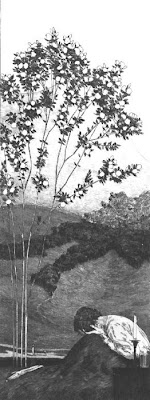
Grunewald: The Temptation of St Anthony
Dreams are a popular research topic for artists in all disciplines. Early explorations of the subject in visual form relate to Jacob's Ladder, and also the Temptation of St Anthony. The latter can be seen in the work of Grunewald right through to more recent artists such as Dali. These might be seen as more illustrational and less personal than say, Goya, with his 'The Dream of Reason Produces Monsters' in 1799, expressing the irrational nature of dreams as a contrast to the rational, at a time when scientists and philosophers were trying to constrain the irrational in the pursuit of reason. Goya was also battling his own demons, and particularly a physical illness that affected his hearing, and perhaps led to pressure in his head, and thus more dramatic dreams.

Goya: The Sleep of Reason Produces Monsters


Yinka Shonibare: The Sleep of Reason Produces Monsters
Some early psychologists explored the optical element within dreams. In the 19th century, Marquis d'Hervey de Saint Denis, (one of the first dream scientists), for example, created 'hypnagogic images' or coloured wheels of light and bubbles. The artists Miro, just into the 20th century, would press the flat bones around the base of his thumb into his eyes to create flashes, or spidery patterns of colour and light which then populated his paintings.

The most interesting, however, are the nineteenth century graphic artists who were well ahead of the scientists of their ages. Grandville demonstrated the visual transformations within dreams, and Klinger who eloquently showed the narrative quality and buried, or surpressed sexual symbolism within them. Redon captured the brooding atmosphere of dreams, and the sense of a separation of consciousness enmeshed with developments in science that were current at the time.

Grandville

Grandville

Klinger: The Glove Cycle
Other artists who have used dreams include Gustave Courbet, who wanted to capture a face/his face at a moment of absolute terror. He engineered it so that he had a nightmare, and then woke up to see his terrified reflection in a mirror placed at the foot of his bed.


Courbet:The Desperate Man 1844
You might also look at any of the surrealists who built their entire movement on the importance of dreams and their meaning based on their reading of Freud's theory of development and psychoanalysis. Dali, de Chirico, and Max Ernst are good ones.

Dali: The Temptation of St Anthony

Finally, you might be interested in looking at Erin Quinn's photographs of dreams, or Joshua Hoffine's photos of childhood nightmares.
 
Erin Quinn

Joshua Hoffine

Saturday, 10 September 2011

Kick off projects on Foundation and BA

I've had a number of queries this week about those exciting but sometimes disconcerting 'First projects' that have been designed to make you rethink how you approach art and design and what it means to be an 'artist' or designer. I have responded to some of these individually by email, especially if there is a very specific request, but there seems to be a common theme throughout many institutions, where students get given a phrase, or a picture each, or perhaps simply a word. They are then left to go forth and develop this in whatever direction they find themselves led. One that came my way this week, was a picture of a wardrobe, and so here I'm going to suggest some ways such a start might be developed.

Tord Boontje's Figleaf Wardrobe
My first thought naturally linked to my fairy heritage. The Victoria and Albert Museum did a mysterious exhibition in 2009 called Telling Tales, and the opening page of their website is a wardrobe made of fig leaves, with the branches of the tree inside, by the amazing Tord Boontje.Telling Tales: Fig Leaf Wardrobe by Boontje This plays on the fact that the body was originally, according to the bible, covered with Figleaves for modesty. Here the figleaves cover the clothes.
In the same exhibition is what looks like a wooden wardrobe by Maartan Baas, but it is really made of steel covered in veneer.

Maarten Baas Steel Wardrobe
The topic could also suggests Narnia  - the idea of hiding in an old wardrobe and finding a door to a world of fantasty - this would lead you in any direction you care to choose!

Check out hangers - here is a gorilla made out of metal hangers by David Mach.

David Mach: Gorilla made of hangers

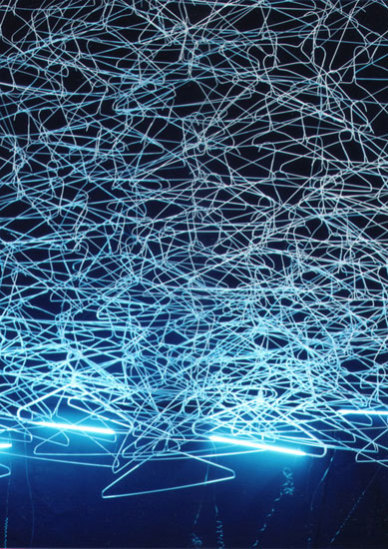
Hanger Chandelier
Hangers are often recycled into interesting structures.


If you wanted to go dark, you could look at hanging, it's history, gallows, and phrases associated with this, such as 'pulling your leg'.


You could look at clothes hooks/pegs - school style. Did you have a picture of a kitten or a tractor to mark your peg?


What about a virtual wardrobe, or 'dressing up' paper dolls. There have been some interesting magnetic versions of this, on, for example, Michelangelo's David.


A wardrobe is a storage space, you might need mothballs - have a look at those. How are they wrapped? What do they look like? What are they made of? What are their links to smelling salts - could you look at connections to smelling salts or camphor.


Varieties of Smelling Salt Bottles
You could look at things that store other things. Campaign trunks, IKEA, boxes, doll's house furniture, etc.

Campaign Trunks
Each time you move onto a new connection, a whole new set of possibilities will reveal themselves. Enjoy!

Saturday, 13 August 2011

Anyone stuck on their summer art, design or fashion project?

If you're stuck on your summer project or dissertation, or need some ideas for contextual referencing, do add a query in the comments box and I will see if I can help....

Friday, 12 August 2011

Beautiful uses for mundane things


Chandeliers offer the opportunity for wonderful flights of fancy, combining innovative contemporary design with delivering atmospheric effects to the spaces they light. They can also be made of things you would normally throw away, and yet look absolutely fantastic! Winnie Lui is a jewellery designer from Hong Kong, and creates either black or white chandeliers from found objects:

Stuart Haygarth has collected random pieces of plastic found on the beach, to create his chandelier 'Tide'. He has also created chandeliers out of old spectacles and used party poppers.


 Frying Pan Chandelier


Guerilla Girls: Tampon Chandelier

     Hanger lights                Heath Nash: Plastic Bottle Lights

Johanna Keimeyer: Plastic bottle Chandeliers

Madeleine Boulesteix's chandeliers  are created from kitchen utensils, glasses and cups.

And finally, a rather gruesome chandelier from the Czech Republic made of the human bones of plague victims.
More bottle art will be added in due course, including some interesting garments.

Wednesday, 3 August 2011

Holiday inspirations

Andres Amador
As you sit on the beach, think what a fabulous creative material sand can be. It can be drawn into, like the work of San Franciscan, Andres Amador and New Zealander, Peter Donnelly, sculpted with, or used for drawing. If you are not one of the two and a half million who have seen the amazing Kseniya Simonova at work, watch this incredible video - she has an interesting background and immense dedication: Kseniya Simonova: Ukraine's Got Talent 


Andres Amador
 

Peter Donnelly


Andres Amador